Some time ago, I had an 1am brain itch:
If Python's for-loop is slow, and list-comprehension is fast - then by how much?
So I ran a benchmark for this.
Result
I ran the same benchmark for all major python versions that I care about. List comprehension is faster in all of them.
The results are:
- 3.8.20 - faster by 13.51%
- 3.9.25 - faster by 12.19%
- 3.10.12 - faster by 10.96%
- 3.11.14 - faster by 4.13%
- 3.12.12 - faster by 2.85%
Here's a graph of the results:
(blue= for loop, orange = list comprehension. Lower is better.)
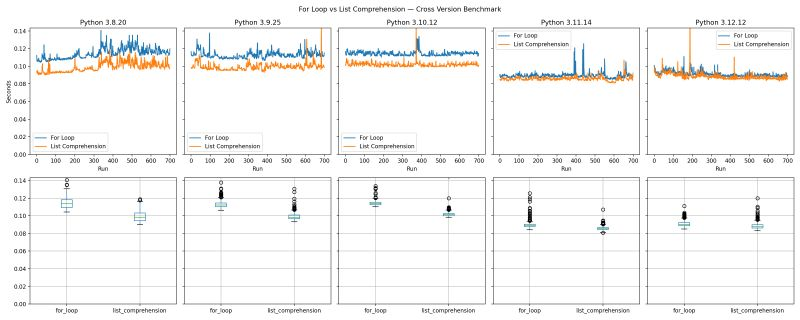
Interestingly, python 3.11 has almost closed the performance gap, and 3.12 closed it up even more.
Quoting a comment by kirill-podoprigora, one of the core python devs, on linkedin: "You should run this benchmark on Python 3.12, since comprehensions are now inlined (see PEP 709), which makes them faster."
Benchmark setup
Each benchmark run processed an array of 1 million integers - once using for-loop, then once using list-comprehension.
The benchmark interleaves the execution of for-loop and list-comprehension, spreading the effect of things like CPU throttling, core-switching etc evenly amongst both methods.
The overall run effectively looks like this:
f = for loop
c = list comprehension
fffffffcccccccfffffffcccccccfffffffccccccc ...

[f(x7 times) c(x7 times)] x100 times
1000 benchmark runs were performed sequentially - alternating between for-loop and list-comprehension in each run. This alternation spread the effect of things like thermal CPU throttling, core-switching etc evenly amongst both methods.
This was the code run for the benchmarks:
import time
import csv
import os
import statistics
import platform

DATA = list(range(1_000_000))
INNER_RUNS = 7
COMPARATIVE_BENCHMARK_RUNS = 100

OUTPUT_FILE = "benchmark_results.csv"

python_version = platform.python_version()


def for_loop():
    result = []
    for x in DATA:
        result.append(x * x + 3 * x + 7)
    return result


def list_comprehension():
    return [x * x + 3 * x + 7 for x in DATA]


def measure_execution_time(fn):
    fn()  # warm-up
    times = []

    for _ in range(INNER_RUNS):
        start = time.perf_counter()
        fn()
        times.append(time.perf_counter() - start)

    return times


if __name__ == "__main__":

    # AIM:
    # Run both methods immediately one after another, leading to an interleaved execution
    # Looks like: fffffffcccccccfffffffcccccccfffffffccccccc...
    # [f(x7 times) c(x7 times)] x100 times

    file_exists = os.path.exists(OUTPUT_FILE)
    file_empty = (not file_exists) or os.path.getsize(OUTPUT_FILE) == 0

    with open(OUTPUT_FILE, "a", newline="") as f:
        writer = csv.writer(f)
        if file_empty:
            print("Output file is empty, so writing CSV header")
            writer.writerow(
                ["python_version", "outer_run", "inner_run", "method", "time"]
            )

        for outer in range(COMPARATIVE_BENCHMARK_RUNS):
            print(f"Running benchmark {outer + 1}/{COMPARATIVE_BENCHMARK_RUNS}")
            for_times = measure_execution_time(for_loop)
            lc_times = measure_execution_time(list_comprehension)

            # write results to csv - for loop
            for i, t in enumerate(for_times):
                writer.writerow([python_version, outer, i, "for_loop", t])

            # write results to csv - list comprehension
            for i, t in enumerate(lc_times):
                writer.writerow([python_version, outer, i, "list_comprehension", t])

    print("Benchmark data written to", OUTPUT_FILE)
System specs
The system used for benchmarking was:
OS: Ubuntu 24.04.4 LTS x86_64
Host: 21ECCTO1WW ThinkPad E14 Gen 4
Kernel: 6.8.0-139-generic
CPU: AMD Ryzen 5 5625U with Radeon G
GPU: AMD ATI 05:00.0 Barcelo
Memory: 38924MiB